
Will I be sued if the words in the AI pictures are wrong? Global Compliance
AI 测评室
May 4, 2026
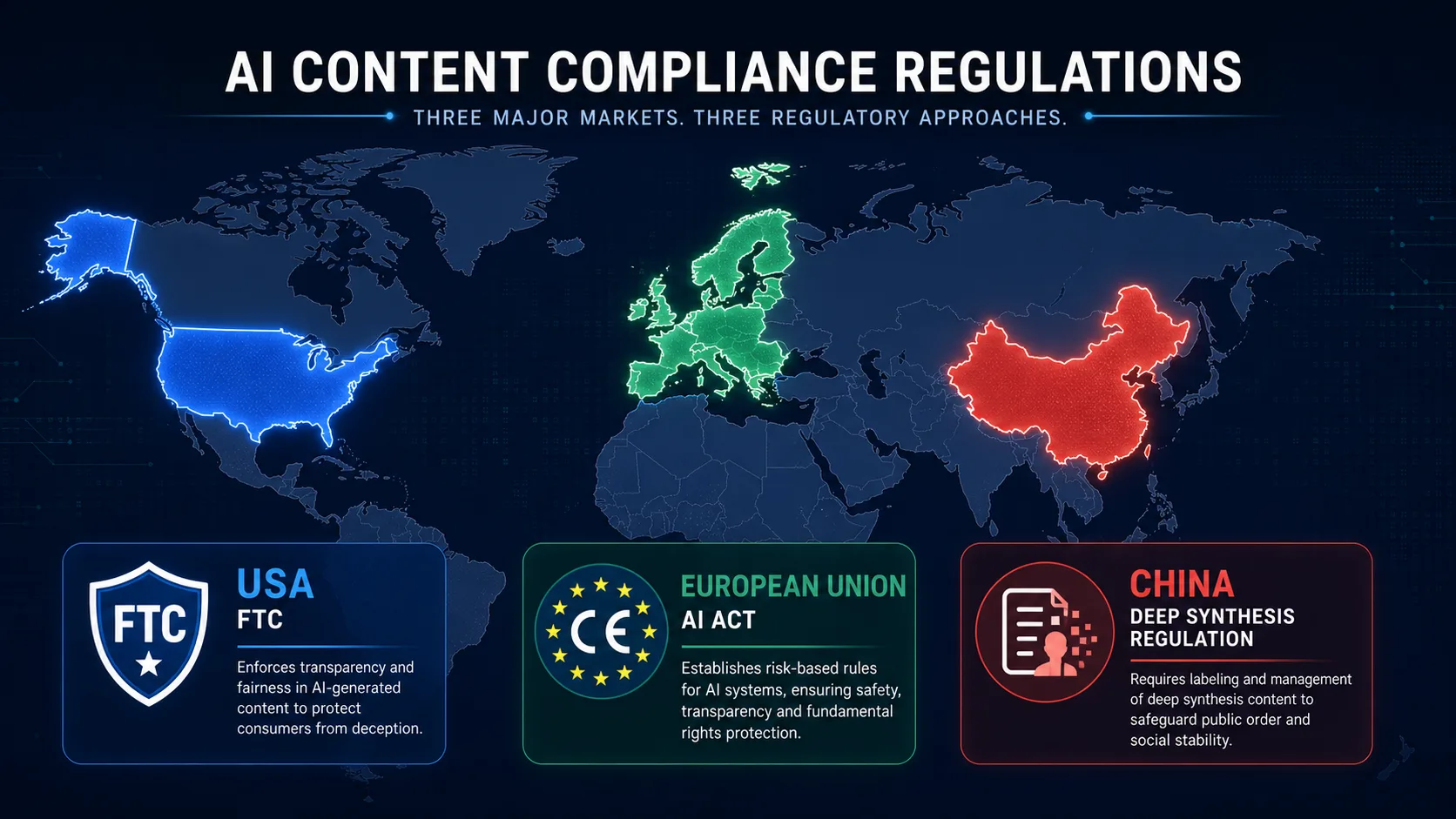
Text modification is not just a design issue - in the three major markets
Text modification is not just a design issue - in the three major markets of Europe, America and China, text errors may trigger advertising laws, intellectual property laws and AI regulatory regulations.
A cross-border e-commerce seller’s nightmare
Imagine a scenario: You are a cross-border e-commerce seller who uses AI to generate a set of product promotional images and distribute them to the United States, Europe and China. Three months later, you received three letters from lawyers at the same time - consumers in the United States complained that product ingredient labels were inconsistent with actual facts, regulatory agencies in Europe questioned your failure to label AI-generated content, and market regulatory authorities in China pointed out that your advertising copy contained misleading statements.
The root cause of the three letters is the same: The text in the picture generated by AI is wrong.
This is not alarmist. As the global AI regulatory framework takes shape, textual errors in AI-generated content are being upgraded from "design flaws" to "compliance risks." This article will help you establish a production compliance system for global teams from the four dimensions of regulatory framework, font licensing, accessibility standards and quality inspection indicators in the three major markets of Europe, America and China.
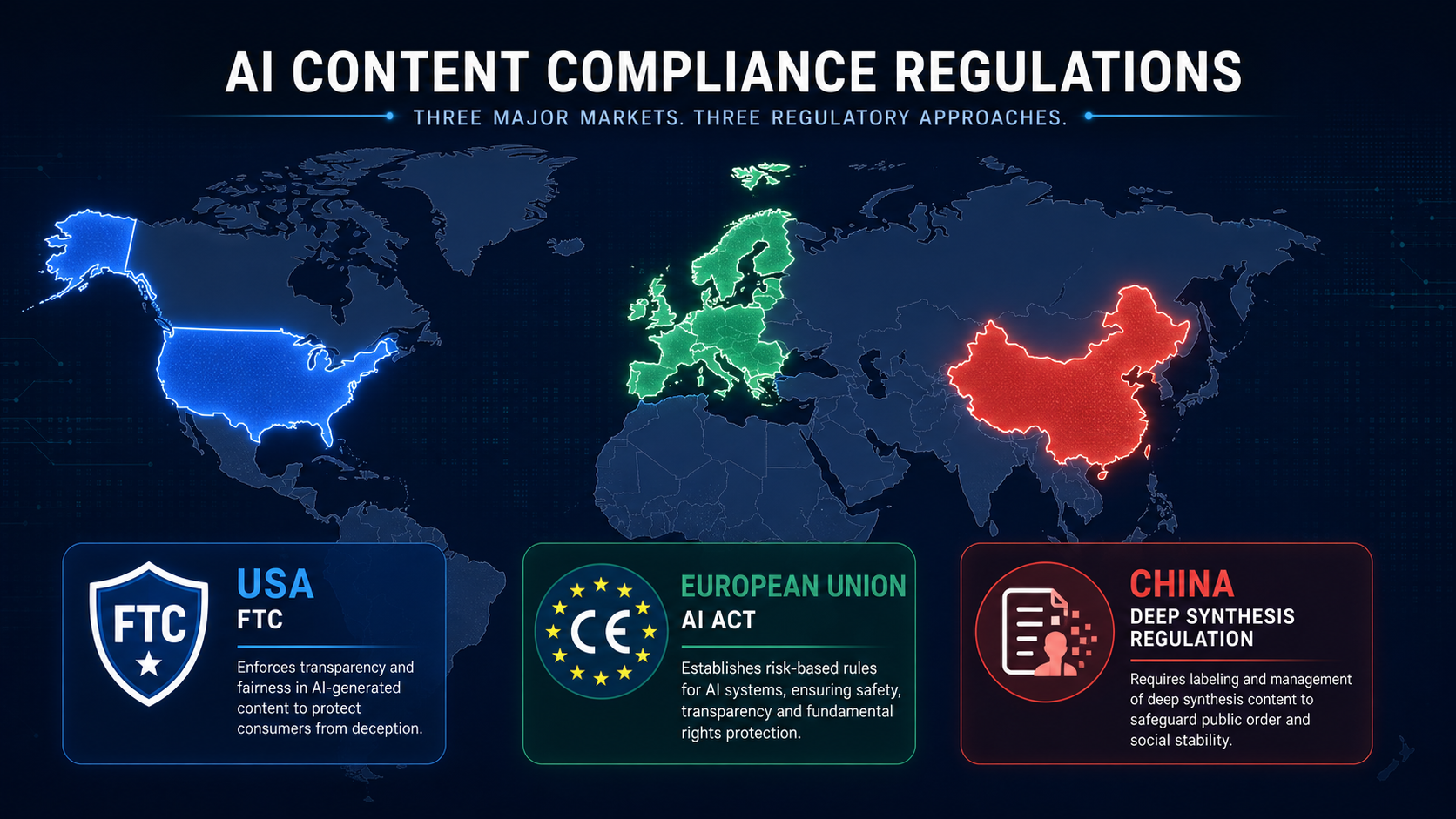
The regulatory framework of the three major markets
United States: FTC Truth in Advertising Principles
The core requirement of the U.S. Federal Trade Commission (FTC) for advertising is truth—all claims in advertising must be factually based and must not mislead consumers.
Falling on the product map generated by AI:
- The description of product ingredients, functions, and effects must be accurate
- Price, discount, and validity period cannot be incorrect
- Do not use false or misleading user reviews and certification marks
The FTC's 2023 AI guidance makes it clear that businesses are responsible for the content generated by the AI tools they use. In other words, "AI generated" is not a reason for exemption - if the ingredient list in the picture is wrong, the responsibility lies with you, not the model.
Practical Impact: If your product images include ingredient lists, instructions for use, or efficacy claims, these texts must be manually verified and cannot rely on AI output.
EU: AI Bill + Consumer Protection
The EU's regulatory system is stricter. The Artificial Intelligence Act (AI Act), which will take effect in 2024, sets out clear labeling requirements for AI-generated content:
- AI-generated text, images, audio and video must have explicit identification (watermark or label)
- Deepfake content must be clearly marked as AI-generated
- High-risk AI systems, including those used for advertising and consumer decision-making, require additional transparency obligations
At the same time, the EU's Unfair Commercial Practices Directive (UCPD) and Consumer Rights Directive have strict requirements on the accuracy of product descriptions. The ingredients, origin, and specifications on product labels must be true and accurate.
Actual impact: AI-generated product images for the European market need to meet two requirements at the same time - label the AI generation source, and the text content in the image is accurate.
China: Deep Synthesis Management Measures + Advertising Law
China’s regulatory framework is rapidly taking shape in 2023-2025:
- The "Interim Measures for the Management of Generative Artificial Intelligence Services" require the identification of images, videos and other content generated by AI.
- "Measures for Labeling of Synthetic Content Generated by Artificial Intelligence" further refines the requirements for explicit labeling and implicit labeling
- The "Deep Synthesis Management Regulations" clearly prohibit the use of deep synthesis to produce and publish false information
- The "Advertising Law" requires that advertisements must not contain false or misleading content, and the description of product performance, functions, ingredients, prices, etc. must be accurate and clear
Actual impact: AI-generated advertising images for the Chinese market require AI content identification, and the product information, prices, and event dates in the images must be accurate. Special categories such as food and cosmetics have additional labeling regulatory requirements.
Cross-Market Compliance Cheat Sheet
| Dimensions | United States | European Union | China |
|---|---|---|---|
| AI content labeling | No federal mandate yet, but FTC recommends transparency | AI Act mandates explicit labeling | Deep synthesis methods mandate labeling |
| Truth in Advertising | FTC Truth in Advertising Principles | UCPD + Consumer Rights Directive | Advertising Law |
| Product labels | FDA (food and drugs), FTC (general consumer goods) | EU regulations (CE marking, ingredient labeling) | National standards + industry standards |
| Font licensing | Copyright law protected font software | Copyright law protected font software | Copyright law protected font software |
| Accessibility | ADA + Section 508 | EN 301 549 | GB/T 37668-2019 |
| Penalty intensity | FTC fine + class action | AI Act up to 35 million euros or 7% of global revenue | Administrative penalty + civil compensation |
Font licensing: the easiest legal trap to step into
Many people don’t know that fonts are copyrighted. When "retouching" characters in AI-generated images, the fonts you use may involve licensing issues.
Commercial fonts
Adobe Fonts expressly states that its fonts can be used for personal and commercial purposes, but are limited to Adobe subscribers during the subscription period. If you cancel your subscription, your work created with Adobe Fonts will continue to be available, but you will no longer be able to create new works using the fonts.
Other commercial fonts (such as Monotype, Linotype) are usually licensed by scope of use - desktop use, web embedding, and app embedding require different licenses.
Open source fonts
SIL Open Font License (SIL OFL) is the most common open source font license. It allows:
- Use, research, modify and distribute fonts
- Embed fonts into documents and software
- Package and redistribute fonts
But there are conditions:
- Fonts cannot be sold individually
- The modified font must be renamed (name preservation clause)
- License file must be retained
Most of the fonts on Google Fonts are SIL OFL and are free for commercial use.
Practical suggestions
-A subscription is required to use Adobe Fonts
- Using Google Fonts’ open source fonts for character modification is the safest free solution
- Before using any commercial fonts, confirm that the license scope covers your usage scenarios (desktop/printing/e-commerce/web)
- Do not use the system's own fonts (such as Microsoft Yahei and Pingfang) for commercial materials - the commercial license of these fonts is controversial
Accessibility standards: not just a matter of "looking good"
AI-generated graphics need to meet accessibility standards if used on a website or digital product. The readability of text is one of the core requirements for accessibility.
WCAG Contrast Requirements
W3C's Web Content Accessibility Guidelines (WCAG) has clear requirements for text contrast:
- Normal text: The contrast ratio between foreground and background colors is at least 4.5:1
- Large text (18pt or above or 14pt bold or above): at least 3:1
- Decorative Text: No contrast requirement
In AI-generated images, the contrast between text and background is often insufficient—especially light text on a light background, or dark text on a complex textured background.
Check method
Use a color picker tool (Photoshop's eyedropper, browser plug-in) to pick the text color and background color respectively, and then use an online contrast calculator (such as WebAIM Contrast Checker) to calculate the ratio.
Practical impact
If your AI-generated graphics are for a website, app, or digital product:
- Ensure text contrast meets WCAG standards
- Avoid small, light text on solid gradient backgrounds
- Higher contrast for key information (price, date, call to action)
Quality inspection indicators: Let data speak, not rely on the naked eye
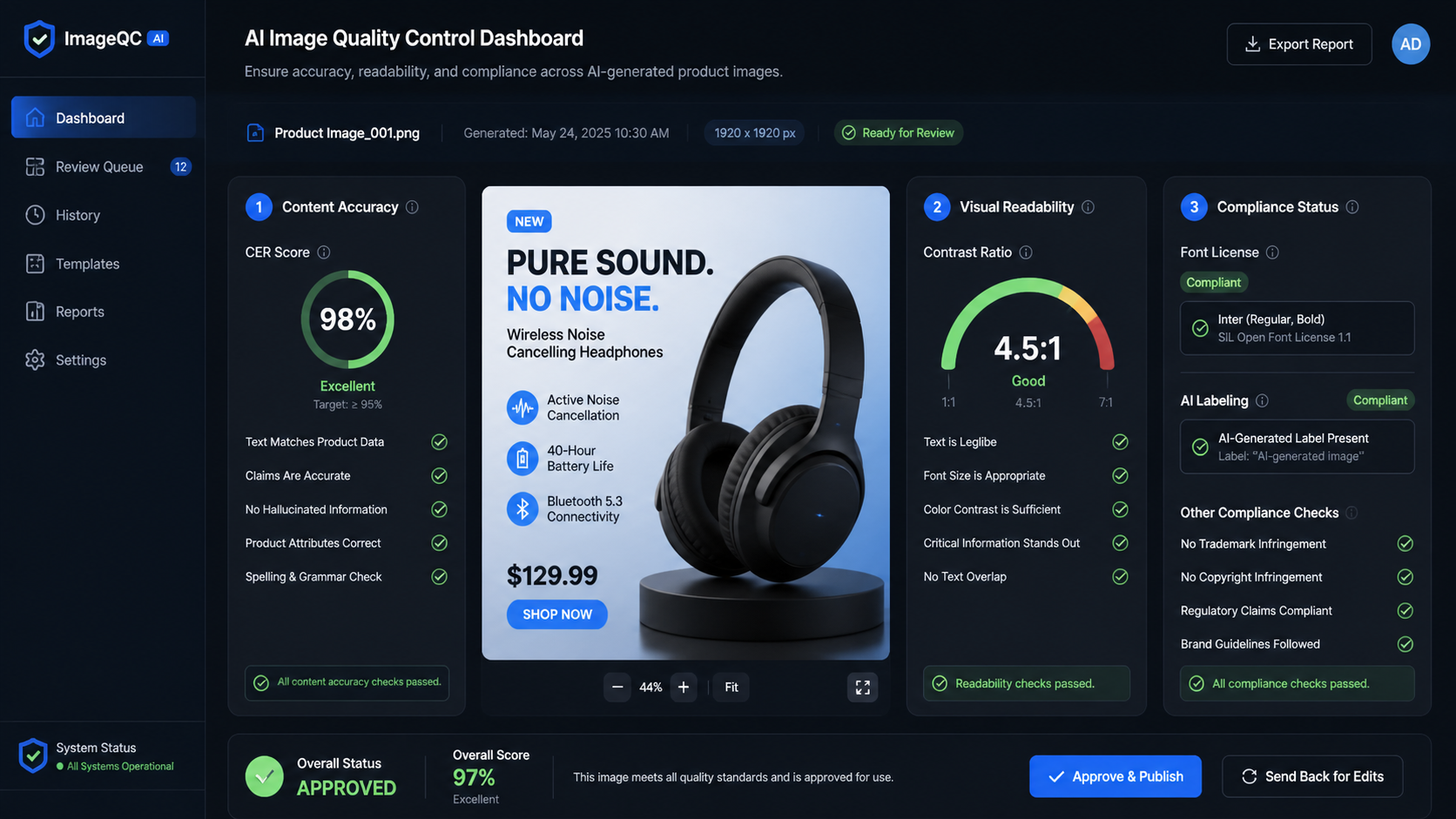
Quality inspection before the film is released cannot just rely on "it looks almost the same". At least three types of indicators should be looked at:
Indicator 1: Content correctness (CER/WER)
CER (Character Error Rate) = edit distance / reference text length WER (Word Error Rate) = word-level edit distance / number of reference words
The lower the better for both. Use OCR to extract the text in the image and compare it word by word with the source copy.
Target value:
- Poster title: CER < 0.05 (max 1 error per 20 characters)
- Product label: CER ≈ 0 (zero fault tolerance)
- Infographic data label: WER ≈ 0 (zero tolerance)
Indicator 2: Visual readability (contrast + resolution)
- Text and background contrast ≥ 4.5:1 (WCAG AA standard)
- Text area resolution is adequate: at least 72dpi for screen use and 300dpi for print use
- Text edges are not obviously jagged or blurred
Indicator 3: Layout stability (consistency check)
- Text size, weight, and spacing at the same level should be consistent
- Uniform line spacing for multi-line text
- Consistent baseline left or center aligned
- The layout structure is consistent between different language versions
OCR quality inspection practice
Recommend PaddleOCR (stronger in Chinese scenes) or Tesseract (mature in English scenes):
# PaddleOCR 校验
paddleocr ocr -i output.png \
  --lang ch \
  --use_doc_orientation_classify True \
  --use_doc_unwarping True \
  --save_path ./qc_output

# Tesseract 导出置信度
tesseract output.png stdout -l chi_sim+eng --psm 6 tsv
Tesseract's TSV output contains a confidence score (0-100) for each character. Key fields (brand name, ingredients, price) should have a confidence level as close to 100 as possible.
Preprocessing before OCR
The accuracy of OCR is highly dependent on image preprocessing:
- Zoom: If the text area is too small, zoom in first and then identify it.
- Binarization: Improve the contrast between text and background
- Denoising: Remove the interference of background texture on recognition
- Correction: Correct image tilt (PaddleOCR has an automatic correction switch)
List of film standards
Going through this checklist before filming can prevent 90% of compliance and quality issues:
Content level:
- [ ] Brand name, product name and registration information are consistent
- [ ] Comparison of ingredient list and actual formula item by item
- [ ] Prices, discounts, and validity periods are accurate
- [ ] The event date and location are correct
- [ ] Consistent content in multiple languages
- [ ] Warnings required by regulation are complete
Visual level:
- [ ] Text contrast ≥ 4.5:1
- [ ] No jagged or blurry text edges
- [ ] Texts at the same level have the same font size and weight.
- [ ] Uniform line spacing and character spacing
- [ ] Resolution for printing purposes ≥ 300dpi
Compliance Level:
- [ ] Font license covers usage scenarios
- [ ] AI-generated content is identified as per target market requirements
- [ ] does not contain misleading statements
- [ ] No infringement of third-party trademarks or copyrights
Technical level:
- [ ] OCR verification passed (CER meets the standard)
- [ ] Key field OCR confidence ≥ 95
- [ ] Barcode/QR code scannable (if applicable)
- [ ] Source copy—OCR results—Proofreading records of the final draft have been archived
One sentence summary
AI-generated text errors are not just design flaws—in the three major markets of Europe, America, and China, they may trigger advertising laws, intellectual property laws, and AI regulatory regulations. The safest strategy is: use OCR for content verification, use contrast tools for visual inspection, and use the font permission list for compliance review. The film can only be released after passing all three levels.
Want to test your production quality inspection process in real scenarios? Use AI to generate a set of product pictures with text on gpt-image2ai.net, and then check them one by one according to the quality inspection checklist in this article - you will find out how many hidden dangers are hidden in the pictures you used to "look almost ready to post".